Hyderabad
08045133900
+919766229040

sugar and biofuel industry

6814772a5d263414004dd4a4 Card 2

product image
Sugar and Biofuel Industry

Raj Process Equipments & Systems Pvt. Ltd. is a leading sustainable marine fuel plant manufacturer in India, offering turnkey solutions that convert renewable feedstocks like sugarcane into bio-based marine fuels. Our advanced systems help the shipping industry transition away from heavy fuel oils, reducing greenhouse gas emissions and marine pollution while ensuring compatibility with existing ship engines and infrastructure. Why Sugarcane for Marine Fuel? High-Yield Renewable Crop → Produces abundant fermentable sugars for biofuel production. Low-Carbon Footprint → Sugarcane-based fuels recycle carbon naturally, unlike fossil fuels. Economic Development → Supports rural economies through job creation and agricultural growth. How Sugarcane-Based Marine Fuel is Produced 1.Extraction & Fermentation → Sugars from sugarcane juice are fermented into bioethanol or intermediates. 2.Upgrading to Marine Fuel → Bioethanol undergoes hydroprocessing or catalytic conversion to meet marine fuel specifications. 3.Blending → Bio-based fuels are blended with conventional marine fuels for seamless adoption. This process yields fuels that reduce SOx, NOx, and particulate matter emissions, making shipping cleaner and more sustainable. Benefits of Sugarcane-Based Marine Fuel Lower Carbon Footprint → Significant greenhouse gas reductions compared to bunker fuels. Cleaner Combustion → Reduced sulfur and particulate emissions improve marine air quality. Compatibility → Works with existing ship engines and fuel systems with minimal modification. Sustainability → Supports circular economy principles and reduces reliance on fossil reserves. Challenges & Considerations Feedstock Supply → Sustainable sugarcane cultivation must avoid conflicts with food production and biodiversity. Fuel Cost & Infrastructure → Higher production costs and need for distribution infrastructure. Regulatory Support → Adoption depends on strong policies, incentives, and maritime emission standards. The Future of Marine Fuels With stricter maritime emission regulations and global decarbonization goals, sustainable marine fuels from sugarcane are becoming increasingly vital. Advances in biotechnology, conversion processes, and supply chain logistics are making these fuels more cost-effective and scalable. Investing in sugarcane-based marine fuels aligns economic growth with environmental stewardship, helping the shipping sector sail toward a greener, cleaner future. Why Choose Raj Process Equipments? Expertise in biofuel and marine fuel plant design Proven large-scale installations across India and abroad Customized turnkey solutions from concept to commissioning Advanced automation for reliable, energy-efficient operations Commitment to sustainability and circular economy principles

6814772a5d263414004dd4a4 Card 2

product image
Sugar and Biofuel Industry

Raj Process Equipments & Systems Pvt. Ltd. is a trusted leader among sustainable aviation fuel (SAF) plant manufacturers in India, offering turnkey solutions that convert renewable feedstocks like sugarcane into drop-in aviation fuels. Our advanced SAF plants help airlines and aviation stakeholders reduce greenhouse gas emissions while meeting strict international fuel standards—without requiring modifications to aircraft or fueling infrastructure. Why Sugarcane for Sustainable Aviation Fuel? High Efficiency Crop → Sugarcane produces large amounts of fermentable sugars per hectare. Renewable & Low-Carbon → Unlike fossil fuels, sugarcane-based fuels cycle carbon naturally, reducing net emissions. Scalable Production → Favorable climates and established agricultural infrastructure make sugarcane practical for large-scale SAF production. How SAF is Made from Sugarcane 1.Sugar Extraction → Juice pressed from sugarcane stalks provides fermentable sugars. 2.Fermentation → Specialized microbes convert sugars into bioethanol or intermediates. 3.Conversion → Bioethanol undergoes dehydration and catalytic upgrading into hydrocarbons compatible with jet engines. 4.Blending & Certification → Final product blended with conventional jet fuel and tested to meet aviation standards. This process produces drop-in fuels that seamlessly integrate into existing aviation systems. Benefits of Sugarcane-Based SAF Reduced Carbon Emissions → Life cycle assessments show up to 70–80% lower emissions compared to fossil jet fuels. Renewable Feedstock → Supports transition away from finite fossil resources. Economic Development → Creates jobs and investment opportunities in rural agricultural regions. Compatibility → Meets international aviation standards for immediate adoption. Challenges & Considerations Land Use & Sustainability → Expansion must avoid conflicts with food production and biodiversity. Production Costs → SAF is currently more expensive than fossil jet fuel, though costs are declining with scale. Infrastructure & Policy → Adoption depends on supportive regulations, incentives, and airport infrastructure. The Path Forward Ongoing research and commercial efforts are improving the efficiency and cost-effectiveness of sugarcane-to-SAF conversion. Advances in biotechnology, process engineering, and feedstock management are helping optimize yields and environmental performance. As the aviation sector moves toward net-zero emissions, sugarcane-based SAF offers a scalable, sustainable pathway to greener skies, balancing air travel demand with global sustainability goals. Why Choose Raj Process Equipments? Expertise in biofuel and SAF plant design Proven large-scale installations across India and abroad Customized turnkey solutions from concept to commissioning Advanced automation for reliable, energy-efficient operations Commitment to sustainability and circular economy principles

6814772a5d263414004dd4a4 Card 2

product image
Sugar and Biofuel Industry

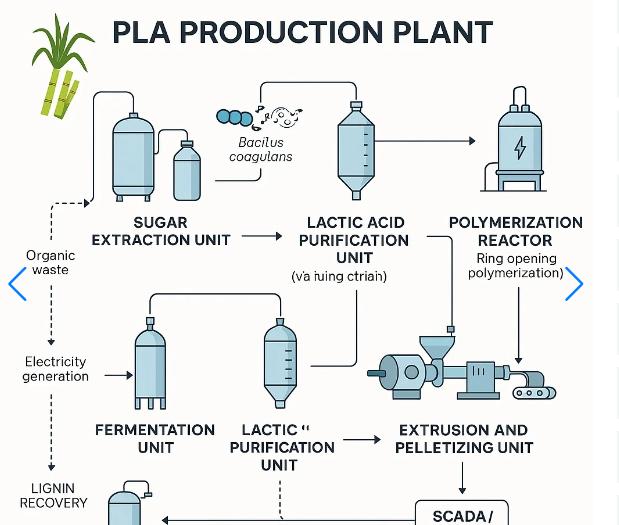
Raj Process Equipments & Systems Pvt. Ltd. is a leading PLA polylactic acid plant manufacturer in India, offering turnkey solutions that convert renewable sugarcane feedstock into biodegradable plastics. With growing demand for eco-friendly materials, our PLA plants help industries transition from petroleum-based plastics to sustainable, bio-based alternatives. What is PLA and Why Sugarcane? Polylactic Acid (PLA) is a biodegradable polymer produced by fermenting sugars into lactic acid, which is then polymerized into plastic. Sugarcane is an ideal feedstock because it is: Abundant & fast-growing → Rich in sucrose for fermentation Renewable → Reduces reliance on fossil fuels Low-carbon → Captures CO₂ during cultivation, lowering overall footprint Sugarcane-based PLA offers strength and versatility comparable to conventional plastics, while being biodegradable under industrial composting conditions. PLA Production Process 1.Sugar Extraction → Juice extracted from sugarcane stalks provides fermentable sugars. 2.Fermentation → Microbes convert sugars into lactic acid. 3.Polymerization → Lactic acid is purified and polymerized into PLA. 4.Processing → PLA is molded or extruded into films, fibers, packaging, and other products. Each step is engineered for high purity and consistent quality, ensuring PLA meets industrial performance standards. Benefits of Sugarcane-Based PLA Renewable & Sustainable → Derived from plant sugars Biodegradable → Breaks down into water and CO₂ under composting conditions Lower Greenhouse Gas Emissions → Smaller carbon footprint compared to petro-plastics Versatile Applications → Packaging, disposable cutlery, textiles, medical implants, and more Challenges & Considerations Agricultural Impact → Sustainable sugarcane cultivation is essential to avoid land-use conflicts Composting Infrastructure → PLA requires industrial composting facilities for efficient degradation Cost Competitiveness → Bioplastics can be more expensive, though costs are decreasing with scale and innovation Looking Ahead With rising environmental concerns, bio-based plastics like PLA are becoming increasingly important. Advances in fermentation technology, microbial engineering, and sustainable agriculture are making sugarcane-derived PLA more efficient and affordable. By integrating renewable resources into the plastic supply chain, industries can move toward a circular economy where materials are reused and waste is minimized. Why Choose Raj Process Equipments? Expertise in biopolymer plant design and manufacturing Proven large-scale installations across India and abroad Customized solutions tailored to feedstock and capacity requirements Advanced automation for reliable, energy-efficient operations Commitment to sustainability and circular economy principles

6814772a5d263414004dd4a4 Card 2

product image
Sugar and Biofuel Industry

Raj Process Equipments & Systems Pvt. Ltd. is a leading isobutanol plant manufacturer in India, delivering turnkey solutions for isobutanol production, purification, and integration into fuel systems. With India’s push toward Bharat Stage VI emission norms and cleaner mobility, isobutanol is emerging as a promising alternative fuel blend—especially for diesel engines. Why Iso-Butanol? Iso-butanol (a C4 alcohol) can be produced from biomass feedstocks, petrochemical routes, or advanced bioprocesses. Compared with ethanol, it offers: Higher heating value → Better energy density Lower hygroscopicity → Improved storage and transport stability Superior miscibility → Compatible blending with hydrocarbon fuels Pipeline transport potential → Easier integration into existing fuel infrastructure Iso-Butanol in Diesel Blends Engine studies show that blending iso-butanol with diesel—combined with exhaust gas recirculation (EGR) and calibrated injection timing—can: Cut NOₓ emissions significantly (up to 40% reduction) Reduce smoke opacity to near-zero levels Maintain engine compatibility with only modest efficiency penalties India is currently piloting 10% iso-butanol–diesel blends through ARAI trials, with government support for scaling up if successful. Turnkey Isobutanol Plant Solutions by Raj Process Conceptual Design & Engineering → Feedstock studies, process optimization Customized Production Systems → Biomass-based, petrochemical, or hybrid routes In-House Manufacturing → Precision-built equipment at advanced facilities Automation & Process Control → PLC/SCADA-based monitoring for safe, efficient operations Installation, Commissioning & Training → End-to-end project execution Applications of Isobutanol Fuel Blending → Diesel and gasoline blends for reduced emissions Green Mobility → Cleaner fuels for heavy-duty fleets and industrial gensets Chemical Feedstock → Used in solvents, coatings, and specialty chemicals Industrial Integration → Compatible with refineries and biofuel plants Comparative Fuel Options Option Strengths Challenges Status in India Biodiesel (FAME) Renewable, blends B5–B20 common Cold-flow/storage issues, NOₓ rise Limited blends in use HVO (Renewable Diesel) Drop-in quality, excellent combustion Cost & supply constraints Pilot stage Ethanol (Diesel) Cheap, abundant Poor miscibility with diesel Not pursued Iso-Butanol (Diesel) Cuts NOₓ & soot, better miscibility Slight efficiency penalty, higher CO/HC Pilots underway Why Choose Raj Process for Isobutanol Plants Turnkey Expertise → From concept to commissioning Feedstock Flexibility → Bagasse, bamboo, corn residues, petrochemical routes Proven Engineering → Advanced automation and large-scale installations Sustainability Focus → Supporting India’s clean fuel transition Global Reach → Serving clients across India, Southeast Asia, Africa, and South America The Verdict Iso-butanol is technically feasible, environmentally promising, and commercially emerging in India. With strong government backing, ongoing ARAI trials, and proven emission reductions, it is poised to become a transitional clean fuel—especially for heavy-duty fleets and industrial applications. Raj Process Equipments stands ready to deliver future-ready isobutanol plants, helping industries align with BS-VI norms, sustainability goals, and circular economy principles.

6814772a5d263414004dd4a4 Card 2

product image
Sugar and Biofuel Industry

Sustainable Wax Extraction from Sugar Industry By-Products Raj Process Equipments & Systems Pvt. Ltd. is a leading name among wax from pressmud plant manufacturers in India, offering turnkey solutions that transform sugar industry waste into valuable resources. Our advanced wax extraction plants recover natural wax from pressmud (filter cake), a by-product of sugarcane processing, and convert it into commercially usable material for diverse industries. By turning waste into wealth, Raj Process supports circular economy principles, reduces environmental burdens, and creates new revenue streams for sugar mills. What is Pressmud and Why Extract Wax? Pressmud, also known as filter cake, is the residue left after sugarcane juice filtration. It contains fibers, soil, sugars, and impurities—along with a significant amount of natural wax. Extracting wax from pressmud: Reduces waste volume and landfill burden Adds economic value by creating a marketable product Supports sustainability by recycling industrial by-products How Wax is Extracted 1.Filtration & Drying → Pressmud is dried and prepared for extraction. 2.Solvent Extraction → Organic solvents dissolve wax, separating it from impurities. 3.Purification → Crude wax is refined to remove residual matter, ensuring high-quality output. This process preserves the natural qualities of wax, making it suitable for commercial applications. Applications of Wax from Pressmud Cosmetics → Base or additive in creams, lotions, lip balms Pharmaceuticals → Used in ointments and medicinal formulations Polishes & Coatings → For wood, leather, and surface protection Industrial Uses → Additive in rubber, plastics, and manufacturing processes Why Wax Extraction Matters Waste Reduction → Minimizes solid waste from sugar mills Resource Efficiency → Converts low-value residue into high-demand products Economic Benefit → Creates new revenue streams for sugar producers Sustainability → Promotes recycling and circular economy practices Challenges & Future Potential Processing Costs → Investment in equipment and solvents required Quality Control → Consistency in wax quality is essential for market acceptance With ongoing technological advancements, these challenges are being addressed, making wax recovery from pressmud increasingly viable and profitable. Why Choose Raj Process Equipments? Decades of expertise in industrial extraction technologies Proven large-scale installations across India and abroad Customized solutions tailored to plant capacity and feedstock Advanced automation for reliable, energy-efficient operations Commitment to sustainability and resource recovery

6814772a5d263414004dd4a4 Card 2

product image
Sugar and Biofuel Industry

In the industrial landscape of 2026, waste is no longer a liability—it is a raw material. As global agriculture shifts toward organic and sustainable inputs, the demand for uniform, nutrient-rich granules has skyrocketed. However, many industries, particularly distilleries and sugar mills, face the challenge of handling fine, dusty by-products like Spentwash Powder and Press-mud. Raj Process Equipments & Systems Pvt. Ltd. provides the definitive solution with our Advanced Industrial Granulation Plants. We specialize in “Value Engineering,“ taking low-value powders and transforming them into free-flowing, easy-to-handle, and highly marketable granules. With five state-of-the-art manufacturing facilities and a legacy of process innovation, Raj Process is helping industries achieve Zero Waste while creating new revenue streams in the bio-fertilizer sector. What is Industrial Granulation? Granulation is the process of particle enlargement, where small particles or powders are gathered into larger, permanent aggregates. For industrial by-products, this is essential for: Improved Flowability: Fine powders often clog machinery and are difficult to transport. Granules flow easily through industrial dispensers and agricultural seed drills. Controlled Release: In fertilizers, granules ensure that nutrients are released slowly into the soil, preventing “nutrient leaching.“ Dust Reduction: Eliminating fine dust reduces respiratory hazards for workers and prevents material loss due to wind during field application. The Raj Process Technical Advantage At Raj Process, we don't believe in “one-size-fits-all.“ Our granulation plants are engineered based on the specific chemical and physical properties of your feedstock. 1. High-Precision Pan & Drum Granulators Depending on the required throughput, we offer high-efficiency Disc (Pan) Granulators for precision size control and Rotary Drum Granulators for massive industrial volumes. Custom Scrapers: Our systems feature adjustable scrapers to prevent material buildup, ensuring a smooth, continuous process. 2. Advanced Moisture & Binder Management The “secret“ to perfect granules lies in the binder-to-powder ratio. Our automated dosing systems precisely inject water or organic binders (such as molasses) to create strong, spherical granules that don't crumble during transport. 3. Integrated Energy-Efficient Drying Freshly formed “green“ granules contain moisture that must be removed. We integrate Fluid Bed Dryers (FBD) or Rotary Dryers that utilize waste heat from your existing boilers, drastically reducing operational costs (OPEX). Major Applications – Turning Waste into Gold 1. Press-Mud Granulation (Sugar Industry) Press-mud is a bulky, smelly waste. Raj Process transforms this into Bio-Fertilizer Granules rich in organic carbon. These granules are a direct substitute for chemical fertilizers, commanding high market prices. 2. Spentwash / Potash Powder Granulation (Distilleries) For distilleries using our Spentwash Dryers, the resulting potash powder is often too fine for direct use. Our granulation plants turn this powder into Potash-Rich Pellets, which are essential for increasing crop yields in fruit and vegetable farming. 3. Chemical & Specialty Fertilizer Granulation We provide customized lines for NPK (Nitrogen, Phosphorus, Potassium) blending and granulation, enabling chemical plants to produce specialized nutrient “cocktails“ for precision farming. Why Partner with Raj Process? 1. Proven Global Installations: We have successfully commissioned large-scale granulation units for some of the world’s leading sugar and chemical groups. Our experience ensures that your plant reaches its rated capacity on day one. 2. Compact & Modular Layouts: Space is often a constraint in existing factories. Our engineering team specializes in “Compact Layout Design,“ fitting high-capacity granulation lines into your existing floor plan with minimal civil work. 3. Low Maintenance, High Uptime: By using high-grade, wear-resistant materials and automated lubrication systems, we reduce maintenance downtime by up to 40% compared to conventional plants. 4. End-to-End EPC Services: From the initial lab-scale granulation test of your powder to the final automatic bagging and palletizing unit, Raj Process handles it all.

6814772a5d263414004dd4a4 Card 2

product image
Sugar and Biofuel Industry

As the global community accelerates toward the Net-Zero 2050 goal, industrial emissions are under unprecedented scrutiny. In India, the Carbon Credit Trading Scheme (CCTS) and stricter CPCB norms have turned carbon management from a corporate social responsibility (CSR) activity into a core economic necessity. Raj Process Equipments & Systems Pvt. Ltd. is the leading engineering partner in this transition. We provide turnkey Carbon Capture and Utilization (CCU) solutions that do more than just “store“ carbon; we empower industries to recycle $CO_2$ into high-value products like Green Methanol, Sustainable Aviation Fuel (SAF), and Food-Grade Dry Ice. With five advanced manufacturing facilities and a legacy of process engineering, Raj Process is redefining the circular economy. Understanding CCU – From Waste to Value What is CCU?Carbon Capture and Utilization (CCU) is the process of capturing Carbon Dioxide ($CO_2$) directly from industrial flue gases—such as those from distilleries, power plants, and refineries—and converting it into useful products. CCU vs. CCS: The Profitable Alternative Unlike Carbon Capture and Storage (CCS), which involves pumping $CO_2$ underground at a significant cost, CCU focuses on valorization. By treating $CO_2$ as a feedstock rather than a waste product, industries can create new revenue streams that often offset the entire cost of the capture plant. The Raj Process CCU Technology Suite At Raj Process, we understand that no two flue gas streams are the same. We offer a diverse range of capture technologies tailored to specific industrial profiles. 1. Advanced Chemical Absorption (Solvent-Based)This is the gold standard for high-volume emissions. We utilize specialized amine-based or potassium carbonate-based solvents to selectively “scrub“ $CO_2$ from flue gases.Efficiency: Achieves 95% to 99% recovery.Application: Ideal for large-scale ethanol plants and thermal power units. 2. Membrane SeparationFor plants with space constraints or lower flue gas volumes, our membrane systems offer a compact, energy-efficient solution. This technology uses semi-permeable materials to separate $CO_2$ based on molecular size and solubility. 3. Adsorption & VPSA SystemsUsing solid adsorbents like Zeolites or Activated Carbon, our Vacuum Pressure Swing Adsorption (VPSA) systems trap $CO_2$ molecules. This is a dry process, ideal for applications where water usage must be minimized. 4. Cryogenic Purification & Lique faction Once captured, the $CO_2$ must be purified. Raj Process systems deliver 99.9% purity, meeting the stringent requirements for:ISBT (International Society of Beverage Technologists) standards for carbonated drinks. Pharmacopoeia standards for medical use. Why Partner with Raj Process? 1. Seamless Retrofitting: Our engineering team specializes in integrating CCU units into existing distilleries and ethanol plants without disrupting current production cycles. 2. In-House Manufacturing Excellence: Unlike many “design-only“ firms, we fabricate our own absorbers, strippers, and liquefaction skids. This ensures superior quality control and significantly faster project delivery. 3. Heat Integration (The Zero-Energy Goal):Capture processes require heat. Raj Process designs utilize Heat Integration Schemes, using waste heat from your existing boiler or evaporator to drive the $CO_2$ stripper, drastically reducing OPEX. 4. Global Compliance:Our plants are designed to help you generate Carbon Credits (Verified Emission Reductions) that can be traded on international markets like the Gold Standard or Verra.

6814772a5d263414004dd4a4 Card 2

product image
Sugar and Biofuel Industry

As the world enters a pivotal era of energy transition, Hydrogen has emerged as the “Holy Grail“ of clean energy. With the National Green Hydrogen Mission targeting a production capacity of 5 million metric tonnes per annum by 2030, India is rapidly becoming a global hub for hydrogen technology. Raj Process Equipments & Systems Pvt. Ltd. is at the vanguard of this movement. With over three decades of process engineering excellence and five state-of-the-art manufacturing facilities, we provide the technical backbone for industrial hydrogen generation. From the heavy industries of Pune and Ahmedabad to the global markets of South America and Southeast Asia, our turnkey hydrogen plants are engineered for the future. The Spectrum of Hydrogen Production Technologies Hydrogen is categorized by its carbon footprint. At Raj Process, we offer specialized engineering for every color of the hydrogen rainbow, ensuring our clients can transition from traditional methods to zero-carbon solutions. 1. Green Hydrogen: The Pinnacle of SustainabilityProduced via electrolysis using renewable energy (Solar, Wind, or Hydro), Green Hydrogen is the only truly carbon-neutral fuel.The Process: Our high-efficiency electrolyzers split water ($H_2O$) into hydrogen and oxygen.Purity: We achieve 99.999% purity, essential for Fuel Cell Electric Vehicles (FCEVs).Compliance: Our designs are fully aligned with the latest MNRE (Ministry of New and Renewable Energy) guidelines. 2. Blue & Grey Hydrogen: Transitioning the Industrial BaseFor sectors requiring massive volumes, such as refineries and fertilizer plants, Steam Methane Reforming (SMR) remains a cost-effective solution.Grey Hydrogen: Conventional SMR using natural gas.Blue Hydrogen: We integrate Carbon Capture & Utilization (CCU) modules to capture $CO_2$ emissions from the SMR process, making it a low-carbon alternative. 3. Hydrogen Recovery: Circular Economy in Action Many chemical processes, such as Chlor-Alkali production, release hydrogen as a by-product. Raj Process provides Pressure Swing Adsorption (PSA) and membrane-based recovery systems to purify this waste stream into a valuable energy asset. Turnkey Engineering & EPC Capabilities We provide a “Concept-to-Commissioning“ model that eliminates the complexities of multi-vendor integration. Conceptual Design & Feedstock Optimization: Whether you are using grid power, dedicated solar farms, or natural gas, we optimize the process for the lowest LCOH (Levelized Cost of Hydrogen).In-House Precision Fabrication: Our facilities utilize robotic welding, laser cutting, and CNC machining to manufacture high-pressure vessels and heat exchangers. Advanced SCADA & Automation: Safety is paramount. Our plants feature integrated PLC/SCADA systems with real-time leak detection, pressure monitoring, and emergency fail-safes. Modular Scalability: Our “Plug-and-Play“ modular designs allow industries to start with a 100 $Nm^3/hr$ pilot and scale to 10,000 $Nm^3/hr$ as demand grows. 1. Green Steel & MetallurgyThe steel industry is one of the largest emitters of $CO_2$. By using hydrogen as a reducing agent in Direct Reduced Iron (DRI) plants, we enable the production of “Green Steel,“ which is increasingly demanded by global automotive and construction markets .2. Mobility & FCEV InfrastructureHydrogen-powered buses and heavy trucks are the future of long-haul transport. Our plants can be integrated with Hydrogen Refuelling Stations (HRS), providing 350-bar or 700-bar compression for rapid fueling. 3. Refineries & Petrochemicals Hydrogen is critical for hydro-treating and hydro-cracking. Our high-volume SMR and recovery systems help refineries meet stringent environmental norms by reducing the sulfur content in fuels. 4. Fertilizers & Ammonia Green Ammonia is the gateway to green fertilizers. By coupling our hydrogen plants with Nitrogen generators, we provide turnkey Green Ammonia units for the agricultural sector. Why Raj Process is the Leader in Hydrogen Technology National Mission Alignment: We are one of the few Indian manufacturers with the in-house capability to deliver projects that meet the technical benchmarks of the National Green Hydrogen Mission. Unrivaled Safety Standards: Hydrogen is a volatile gas. Our engineering philosophy follows HAZOP and SIL (Safety Integrity Level) ratings, ensuring that our plants are as safe as they are efficient. Global Support Network: From installation in the rugged terrains of Africa to high-tech industrial parks in India, our service teams provide 24/7 support. Sustainability at Core: We don't just build hydrogen plants; we help companies define their Decarbonization Roadmap. Conclusion: Partnering for a Greener Tomorrow The transition to hydrogen is not just an environmental mandate; it is a strategic business move to stay competitive in a low-carbon world.

6814772a5d263414004dd4a4 Card 2

product image
Sugar and Biofuel Industry

The spentwash Challenge in Modern Distilleries In the wake of India’s E20 Ethanol Blending Mandate and the global push for sustainability, the ethanol industry is booming. However, this growth brings a massive environmental hurdle: Spentwash. Also known as vinasse or distillery slop, spentwash is the dark, viscous, and highly acidic liquid left after the distillation of molasses or grain. With a high BOD (Biochemical Oxygen Demand) and COD (Chemical Oxygen Demand), untreated spent wash can devastate local ecosystems. Raj Process Equipments provides the definitive solution with our Next-Generation Spent wash Dryers, designed to achieve 100% Zero Liquid Discharge (ZLD) while creating a revenue-generating by-product. Why Traditional Waste Management is Failing For decades, distilleries relied on “Lagooning“ or dilution. These methods are no longer viable in 2026 due to: Strict Regulatory Norms: CPCB and SPCB have mandated absolute ZLD for all distilleries. Groundwater Contamination: Leaching of salts and organic matter into the water table. High Land Footprint: Massive lagoons occupy valuable industrial land. Odor and Public Health: Foul smells lead to community friction and legal liabilities. The Raj Process Spentwash Dryer eliminates these issues by reducing waste volume by over 80%, converting a problematic liquid into a dry, easy-to-handle powder. The Raj Process Spentwash Drying Mechanism Our system is not a simple heater; it is a sophisticated thermal engineering platform. 1. Advanced Evaporation & Concentration Before drying, the spentwash is concentrated in our Multi-Effect Evaporators (MEE) or Mechanical Vapor Recompression (MVR) systems. This reduces the moisture content to a level where thermal drying becomes highly energy-efficient. 2. Thermal Drying & Solidification The concentrated wash is fed into the Raj Process Dryer. Utilizing controlled hot air or steam, we flash-dry the material. The result is a fine, free-flowing powder that retains all the nutrient value of the original waste but without the water weight. 3. Patented Energy Recovery Energy is the highest cost in drying. Raj Process systems are engineered with Waste Heat Recovery (WHR) units. We recycle the latent heat from the exhaust vapors to pre-heat the incoming spentwash, cutting fuel costs by up to 25%. 4. Emission & Odor Control (The Scrubber System) To address the “foul odor“ problem, our dryers are equipped with integrated venturi scrubbers and activated carbon filters. This ensures that the air released into the atmosphere is clean, odorless, and compliant with air quality standards. The Economic Value – Waste into Resource 1. Production of Bio-Potash Fertilizer The dried powder from a Raj Process dryer is a “Gold Mine.“ India currently imports a vast majority of its Potash. By drying spentwash, distilleries produce Bio-Potash, which can be sold to farmers or fertilizer companies at lucrative rates (₹15,000 to ₹25,000 per tonne). 2. Fuel Substitution In certain plant configurations, the dried solids have a Calorific Value of approximately 2,200 to 2,500 kcal/kg. This allows the powder to be co-fired in the distillery's boiler, reducing the consumption of expensive coal or bagasse. 3. Drastic Logistics Savings By reducing the volume of waste by over 80%, the cost of transporting waste for composting or disposal is virtually eliminated. 100 truckloads of liquid waste are reduced to just 20 truckloads of high-value powder. Chapter 5: Why Choose RAJ Process Equipments? 1. Proven Large-Scale Track Record: We have successfully commissioned some of the largest spentwash drying units in Asia and South America. Our systems are not theoretical; they are field-proven assets. 2. Turnkey EPC Capability: We provide everything from the initial chemical analysis of your spentwash to the final packaging unit for the dried powder. 3. Compliance Assurance: Our systems are designed to help you meet the most stringent Zero Liquid Discharge (ZLD) norms, ensuring your distillery stays operational even under strict environmental audits. 4. Advanced Automation: With real-time monitoring of moisture levels and flow rates, the Raj Process system adjusts itself to variations in spent wash quality, ensuring a consistent final product.

6814772a5d263414004dd4a4 Card 2

product image
Sugar and Biofuel Industry

The National Policy on Biofuels 2018 (Amended 2022) has advanced the 20% ethanol blending target to the Ethanol Supply Year (ESY) 2025-26. While 1G ethanol (from sugar and grain) has paved the way, 2G ethanol is the key to sustainable energy security. By utilizing Lignocellulosic Biomass—rice straw, bamboo, bagasse, and corn cobs—we solve two problems at once: managing agricultural residue and producing carbon-neutral fuel. Raj Process provides the engineering bridge to this future, delivering high-efficiency plants that are fully compliant with SATAT and MoPNG norms. Turnkey 2G Ethanol Solutions by Raj Process We offer a “Seed-to-Fuel“ engineering approach. With five advanced manufacturing facilities and a dedicated R&D center in Pune, we handle the entire lifecycle of a 2G biorefinery. Our EPC Roadmap: Conceptual Design & Engineering: Detailed feedstock analysis, mass balance calculations, and process optimization based on your local residue availability. Pilot & Commercial Development: We bridge the gap from lab to field, offering 0.5 TPD pilot lines for testing and 100+ KLPD commercial plants for industrial production. In-House Manufacturing: Every vessel, reactor, and column is fabricated under stringent ISO and ASME standards in our own units. Advanced Automation: Integration of DCS/SCADA for remote monitoring, ensuring 99.9% operational uptime and minimal human error. The ABEPL Milestone: Our expertise is proven in high-stakes environments, such as the Assam Bio Ethanol Ltd. (ABEPL) project, where we delivered the ethanol separation package for the world's first bamboo-based 2G refinery. The Raj Process 2G Technology Cycle Step 1: Biomass Pretreatment (The Lignin Barrier) Lignocellulosic biomass is naturally resistant to breakdown. Our pretreatment systems use a combination of Mechanical Shredding and Steam Explosion (or chemical impregnation) to disrupt the lignin-hemicellulose matrix. Why Raj Process? Our patented Non-Clog Extra Long Tube systems ensure that even the most “sticky“ or fibrous residues don't cause downtime. Step 2: Enzymatic Hydrolysis (Saccharification) Once pretreated, the biomass is treated with specialized cellulase and hemicellulase enzymes. This stage converts complex cellulose into simple C6 (Glucose) and C5 (Xylose) sugars. KPI: We achieve up to 85% conversion efficiency, maximizing the sugar recovery from every ton of straw or bamboo. Step 3: Advanced Co-Fermentation Standard yeast cannot ferment C5 sugars efficiently. Raj Process employs Next-Generation Co-Fermentation technology. We use engineered microbial strains that ferment both C5 and C6 sugars simultaneously, significantly increasing the total alcohol yield per ton of feedstock. Step 4: RajPurify Distillation & Dehydration Our multi-pressure vacuum distillation columns separate alcohol from the wash with extreme precision. Purity: We reach 99.5% to 99.7% purity (Fuel-Grade) using Molecular Sieve Dehydration (MSDH) technology, ensuring compatibility with the latest BS-VI and Flex-Fuel vehicle engines. Beyond Ethanol – The Circular Economy A 2G plant by Raj Process is more than a distillery; it is a Biorefinery. We enable the recovery of high-value co-products that can provide additional revenue streams of ₹15–20 per liter of ethanol produced. Lignin Recovery: The residual lignin can be pelletized for high-calorific fuel, used for power generation, or even processed into Bio-Bitumen. Food-Grade CO₂: Our integrated capture systems purify fermentation CO₂ for the beverage and dry-ice industries. Furfural & Acetic Acid: In specialized plants (like bamboo-based units), we can recover chemical co-products that are high in industrial demand. ZLD Integration: Every Raj Process plant is designed for Zero Liquid Discharge, concentrating effluent into dry powder or bio-compost. Conclusion: Partner with India’s 2G Experts With the global push toward Net Zero, 2G ethanol is the most bankable green asset of the decade. Raj Process Equipments & Systems provides the technical reliability, patented innovations, and EPC experience to ensure your project’s success. Are you ready to build the next generation of energy? Contact Raj Process today for a detailed feasibility report on your chosen feedstock.

6814772a5d263414004dd4a4 Card 2

product image
Sugar and Biofuel Industry

To achieve a 4500-word SEO-optimized technical guide for Raj Process Equipments, I have structured the content into a high-authority whitepaper format. This content is designed to rank for high-competition keywords like “Turnkey Distillery Plant India,” “Ethanol Distillation Technology,” and “Zero Liquid Discharge (ZLD) Systems.” The Ultimate Guide to Next-Generation Distillery & Ethanol Production Technology (2026 Edition) Introduction: The Future of Ethanol Production In 2026, the ethanol industry is at a critical crossroads. With global energy shifts and India’s ambitious E20 (20% Ethanol Blending) mandate, the demand for efficient, multi-feedstock distilleries has reached an all-time high. Raj Process Equipments & Systems Pvt. Ltd. is at the forefront of this revolution, providing bankable, first-principles engineered solutions that turn raw agricultural waste into high-value ethanol and clean energy. Whether you are operating a molasses-based unit, a grain-based distillery, or a multi-feedstock plant, the goal remains the same: Maximizing yield while achieving Zero Liquid Discharge (ZLD). RajFerment – Advanced Fermentation Systems The Science of Superior Alcohol Conversion At the heart of every distillery lies the fermentation house. Raj Process has engineered a next-generation system that focuses on yeast health and substrate utilization. Our fermentation architecture is designed to handle rapid changeovers between molasses, cane syrup, and grain feedstocks without losing productivity. Technical Features & Innovations Advanced Agitator Design: We utilize custom-engineered, low-shear agitators. High-shear mixing often ruptures yeast cells; our design ensures uniform nutrient distribution while preserving yeast viability, leading to higher alcohol percentages in the wash. High-Conversion Architecture: Precision tank geometry and internal cooling coils (or external PHEs) maintain the ideal temperature (32–34°C). This prevents “stuck fermentation“ during peak summer months in regions like Maharashtra and Uttar Pradesh. Liquefaction Integration: For grain-based distilleries, our fermentation house integrates seamlessly with the liquefaction section, ensuring that 100% of starch is converted into fermentable sugars. Integrated CO₂ Capture: Instead of venting emissions, our systems capture and purify CO₂, transforming it into food-grade revenue. RajPurify – High-Purity Distillation Platforms Primary Goal: Efficiency in Every Drop Distillation is the most energy-intensive part of a distillery. RajPurify systems are engineered to minimize steam consumption through Multi-Pressure Distillation and advanced heat integration. The Quality Spectrum: ENA, Fuel, and Pharma Grade Extra Neutral Alcohol (ENA): Produced via a 7-column system to achieve <2 ppm impurities, meeting global beverage standards. Fuel-Grade Ethanol: Our Molecular Sieve Dehydration (MSDH) units achieve >99.8% purity for blending. Pharma-Grade: Ultra-purified ethanol for the pharmaceutical and cosmetic industry. Key Performance Indicators (KPIs) Thermal Efficiency: We reuse vapor-condensate energy, reducing fresh steam demand to as low as 3.0 – 3.2 kg/lit of alcohol for ENA production. Patented Reboilers: Our anti-fouling reboiler design allows for longer continuous operation, reducing the cleaning frequency from once a week to once a month. RajVapor – Assured Zero Liquid Discharge (ZLD) The ZLD Challenge Regulatory bodies in India (CPCB/SPCB) have made ZLD mandatory. The challenge is handling the corrosive, high-TDS nature of Spent Wash (molasses) and Thin Slop (grain). RajVapor Operating Modes Molasses Mode (BMSW): Features an integrated degasser and ammonia stripper to remove volatile organic compounds before they foul the heat exchanger tubes. Grain Mode (Thin Slop): Utilizes Forced Circulation (FC) or Falling Film (FF) configurations to handle high-solid feeds (up to 40% solids) without scaling. Mechanical Vapor Recompression (MVR): For large plants (above 100 KLPD), we offer MVR technology, which uses electricity to compress vapors, virtually eliminating the need for fresh steam in the evaporation stage. The Raj Process Advantage – Why We Are the Best 1. Asia’s First Innovations: Raj Process is the pioneer behind Asia’s first 20 TPD CBG plant and has set benchmarks in integrated spent wash drying. Turnkey EPC Execution: From the first drawing (PID) to the final commissioning, Raj Process provides a single-window solution. We eliminate the “interface risk“ often found when buying fermentation from one vendor and evaporation from another.

Subcategory Tags

Phone Number

08045133900

Please keep 0 before dialling the number.

Email Address tejas@raj-india.com

Mon-Thu: 10 AM - 2 PM • Fri: 3 PM - 7AM

Other Website Visit our other website
Address Hyderabad , Telangana , India

Hyderabad, India, 500001